
Let us first try to simplify the jargon “Brand Localization“. The term refers to the efforts of companies to reach out to a certain local region and cater their needs at the very base, while maintaining their national/international brand presence. For example, a Coca-Cola can in Tokyo will have everything written in a Japanese language. It is important for companies to create an international identity in the market, but the localization gives it a personal touch and drives sales.
The event “Brand Localization Summit” was organized by Sandbox and LocalWave on Oct 6th, 2016 at the Chicago HQ of Sandbox. The speakers and attendees flew from all over the country. The event started off by “Opening Remarks and Welcome Ceremony” by Ethan Whitehill, (Principal, Sandbox) and Angela Potts, (Managing Director, Sandbox). They emphasized on the fact that the local brand advocates are a more powerful media channel than the national advertising. They mentioned 3 barriers in the process of localization that companies face: language, measurement and the culture. A comparison was then laid out between Local Store/Field Marketing and Brand Localization. They differ in the sense that the field marketing is trying to distribute the assets whereas Brand Localization is trying to share the culture.
The next session was “State of Local Marketing” by Anne Marie Stephen, (CEO of Kwolia). She brought out an important state in today’s world which is that the technical folks and the end user does not speak the same language. A result from a survey of 300 CMOs was shown which revealed that Social Media and Location/Wifi are the top interests in the industry. While discussing about “location”, she showcased it as a 3 layer cake: Drive traffic (to your stores), Increase the basket (interact with your customers), and close the deal. She summarized her session by stating that Location-based marketing (LBM) is not just mobile, but the integration of people, places and media.
The next session was “Your Brand Story at the Local Level” by Tammy Broaddus, (Principal, Overflow Storytelling Lab). This was probably the most touching session of the day as it involved various stories. She formulated on how stories change and transform the brand behavior through diffusion and innovation. She callled out the “Brand” as the hero of the story. On “Innovation”, she said that it is communicated through certain channels over time among members of a social system. She then listed the attributes of innovation: Relative Advantage, Compatibility, Trialability, Observability and Complexity.
The next session was “Local Digital Marketplace“, by Tom Kuhr, (SVP Marketing , Momentfeed). The talk was more towards the digital marketplace, e-commerce and online stores. An important question raised by him was if you are in such a business with endless number of products which in turn makes it an endless number of webpages, then as a marketer, how many pages should you manage. A surprising fact laid out was that the online stores have more than 10 times the influence on brand than a retail store, precisely because of the customer being more picky on a virtual environment. Effective mobile marketing requires brands to act as if they were only communicating from a store, shop or a restaurant. He went on and mentioned 3 things that brands must do in a digital marketplace: Expand Reach (Embrace Local Fans), Build Loyalty (Leverage your audience by engaging with the reviews both good and bad), and Boost Awareness (Optimize your Social ads).
A lunch break commenced with an amazing service from the Sandbox and Localwave team. I have never been to a networking event where I would have an exclusive food, custom-made, waiting for me with my name on it.
After some good meals, tiring flights early morning and a rainy weather, it was slightly expected that people might fall asleep, however, the next session let no one blink an eye. It was “Interactive Local Brand Experience” by David Odham (SVP Production) and Zack Kattermann (Brand Manager) from Pearl Media. It was the most energetic and fun session of the day. They started off with a simple but effective statement that Brand experiences matter because creating a memory is important to you, it creates a lasting impression.
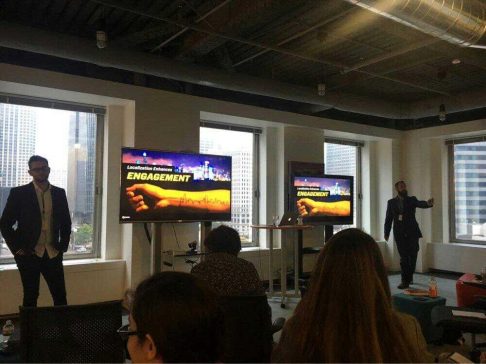
Being in a company that does interactive localization every single day, they laid out 5 rules of Brand Localization:
- Start Big!: The idea should have a big picture in mind.
- Start Local: One step at a time.
- Talk to the experts (Customers): Increase Consumer interactions.
- Shake it up: Innovate Out-of-the-Box, think different ways if one is not working.
- Have a point: Know exactly what you want to do.
With each rule they shared a project from their portfolio to show how the random people start engaging with their live experiential.
The next session was ” Brand Highlights: Living Local” by Chris Brulatour, (Director of Research and Planning, Sandbox). An interesting quote by Simon Sinek that Chris stated was People don’t buy what you do, they buy why you do it. He took the crowd on a journey on start with a why to inspire someone and in turn inspire action. One shall start with their culture and being true to their guiding principles. This will inspire people to believe in the brand and then use the brand to bring people together. One must sustain this effect with time by constantly building relationships with people inside and outside the organization, doing good for the community, bringing them together, taking care of them, and they will then take care of you.
The next session was an introduction of “Localwave Platform: Sylavan Learning” by Angela Potts, (Managing Director, Sandbox). The session showed how the Cloud-based Platform, Localwave helped in the brand localization of Sylvan Learning, an online tutorial service. The need for such a tool was stated because of the increasing TV spending with a limited return on investment. It helped them achieve their marketing alignment for national regional and local trade area, with an activation of the local brand.
The finals session was a “Group workshop” moderated by Ethan Whitehill, (Principal, Sandbox). Representatives of a certain company would come on the stage and discuss their problems in brand localization, their efforts and what an ideal outcome would they like to achieve. The remaining attendees will brainstorm more and offer appropriate advice. Two companies Applebees and Sprint participated in this workshop.
The challenge with Applebees was a low local presence in Chicago area. They made certain efforts to provide more to the local communities through Make-a-wish foundation. However, these efforts were not working. They ideally want their restaurants to be a fun-hangout place with a family feel with the majority of the crowd being from 18 – 45 years of age. They mentioned creating different decors for different local areas. My personal suggestion would be to add an additional “Local” menu for Food and Beverages to drive more local feel to the restaurant and drive it away from the image of a national chain restaurant.
The challenge with Sprint was that in Chicagoland area previously, Sprint did not have a good network, thus, lot of people switched. However, now that they have made the connection fast and superior, they still face a perception of being a weak network as compared to Verizon. Ideally they are looking to drive traffic in their stores and they have made multiple efforts in the past by sponsoring various events, painting the whole town yellow, etc. An interesting point was raised by Tom Kuhr that Word of Mouth sells more in changing loyalty which can be leveraged through a loyal customer base that Sprint has in Chicago (1 yr or more). My personal suggestion would be to offer them a special discounted plan if they could record their short video with the precise location in Chicago and their superb experience with Sprint as a head-start. Then these videos from different locations could be compiled together and later zoomed out on the map of Chicago and show how strong this connection does Sprint have, not only technically but also with their customers. This video could be broadcasted in-store, Chicago local TV ads, etc. Another option could be to have special data packages during Cubs/Blackhawks/Bears/Bulls games. A special offer for new customers could be made where during the game nights (3 or 4 hrs), Sprint offers free streaming data for those games. Regular users could also upgrade to this option if you get enough new users to offer this service. (Cost/Benefit analysis).
The summit then ended with networking with like-minded folks, exchanging ideas and a few beers.
“People don’t buy what you do, they buy why you do it.-Simon Sinek”
 SMarketinGuru